
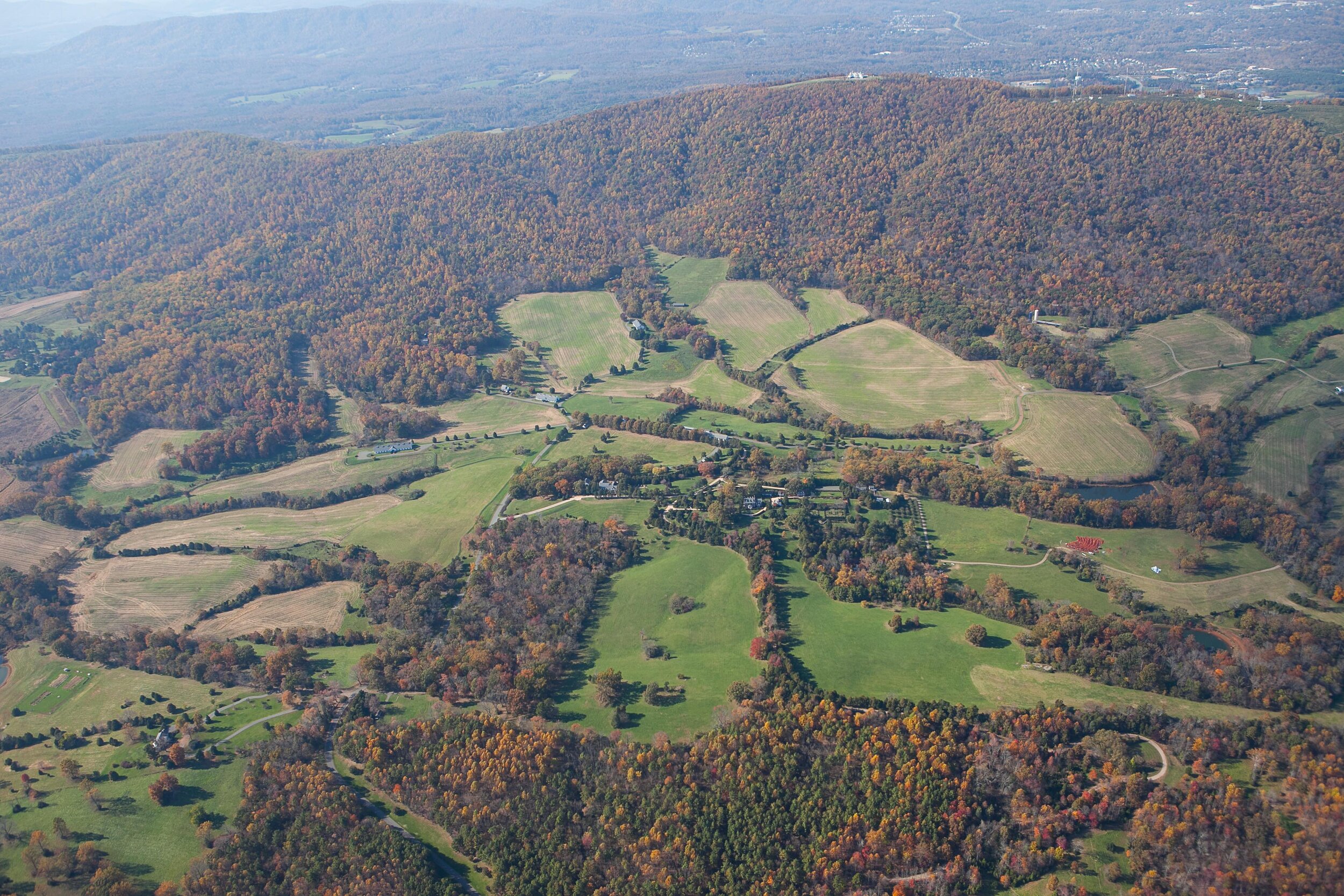
Colonial Experimentation and Plantation Agriculture: 1730 - 1906
The first European settler to claim these Monacan lands was John Carter III, Secretary of the Virginia Colony, who was granted a 9,350-acre royal land grant from the King of England in 1730. Carter, whose family owned Shirley Plantation east of Richmond, valued this land grant for its extraction possibilities—metals, stone and timber—as much as its agricultural potential. His son William Champe Carter sold one of the quarter plantations he inherited, Dick’s Plantation, to William Short in 1795. Other quarter farms on the plantation included Redlands, Blenheim, and Highland. It was Thomas Jefferson who selected and purchased this land on behalf of Short to encourage him to settle near Monticello and become part of a learned society that included James Madison and James Monroe, also nearby. Jefferson had employed Short as his secretary while he was minister to France and Short went on to become a career diplomat.
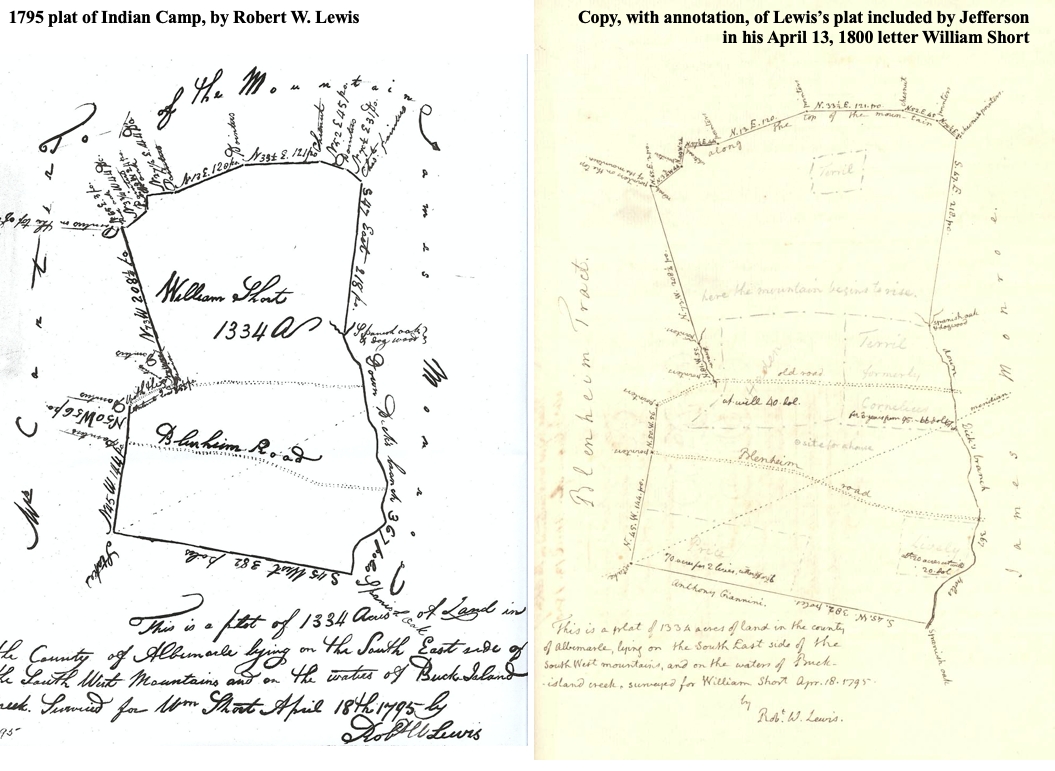
The survey and deed that record the Dick’s Plantation sale describe the property as “Indian Camp,” in reference to the traces of recent Monacan presence on the land. These traces included an “ancient road” that crossed the property at the base of Carter’s Mountain, and a creek named “Indian Camp Branch.” More than once, Jefferson made a copy of the Indian Camp survey, and each copy conveys valuable information on the property’s natural and manmade features. He described the land’s qualities both in prose and in drawings, even indicating on an 1800 survey an advantageous house site. Jefferson wrote, “I never saw a more fortunate position than there is on it for a house.” William Short never lived on the property, however, but he did persuade Jefferson to establish a period of experimental tenant farming at Indian Camp as an economic alternative to southern plantations that operated using enslaved labor.
In Short’s absence, Jefferson experimented with regenerative crop rotation, with the tenant farmers and their enslaved laborers growing a rotation of wheat, corn, rye, potatoes, and red clover. Tenant farmers at Indian Camp included Joseph and Lucy Price, Charles Lively, George Haden, Richard Shackelford, and Robert Terril. After Short and Jefferson’s 15-year-long Indian Camp experiment, and extensive correspondence about the moral and economic problems of slavery, Short decided to settle in Philadelphia, rather than Virginia.
William Short sold Indian Camp to David Higginbotham in 1813. Higginbotham was a successful merchant at the nearby port of Milton, on the Rivanna River, and he supplied a range of domestic and imported goods to local plantations and small country stores along the James River & Kanawha Canal. The sale was brokered by Jefferson as part of a three-way deal to satisfy his own debt to Higginbotham. Higginbotham and his wife Mary Garrigues Higginbotham renamed the property “Morven,” likely in reference to the sublime landscape setting of a popular 18th century Scottish romantic poem, Ossian, published by James McPherson. They commissioned Martin Thacker, the builder of Redlands, one of the Carter homes, to build the Morven house between 1818-1820. Though Jefferson drew a house plan for Higginbotham—and in the past was credited with designing Morven—that plan was never executed.
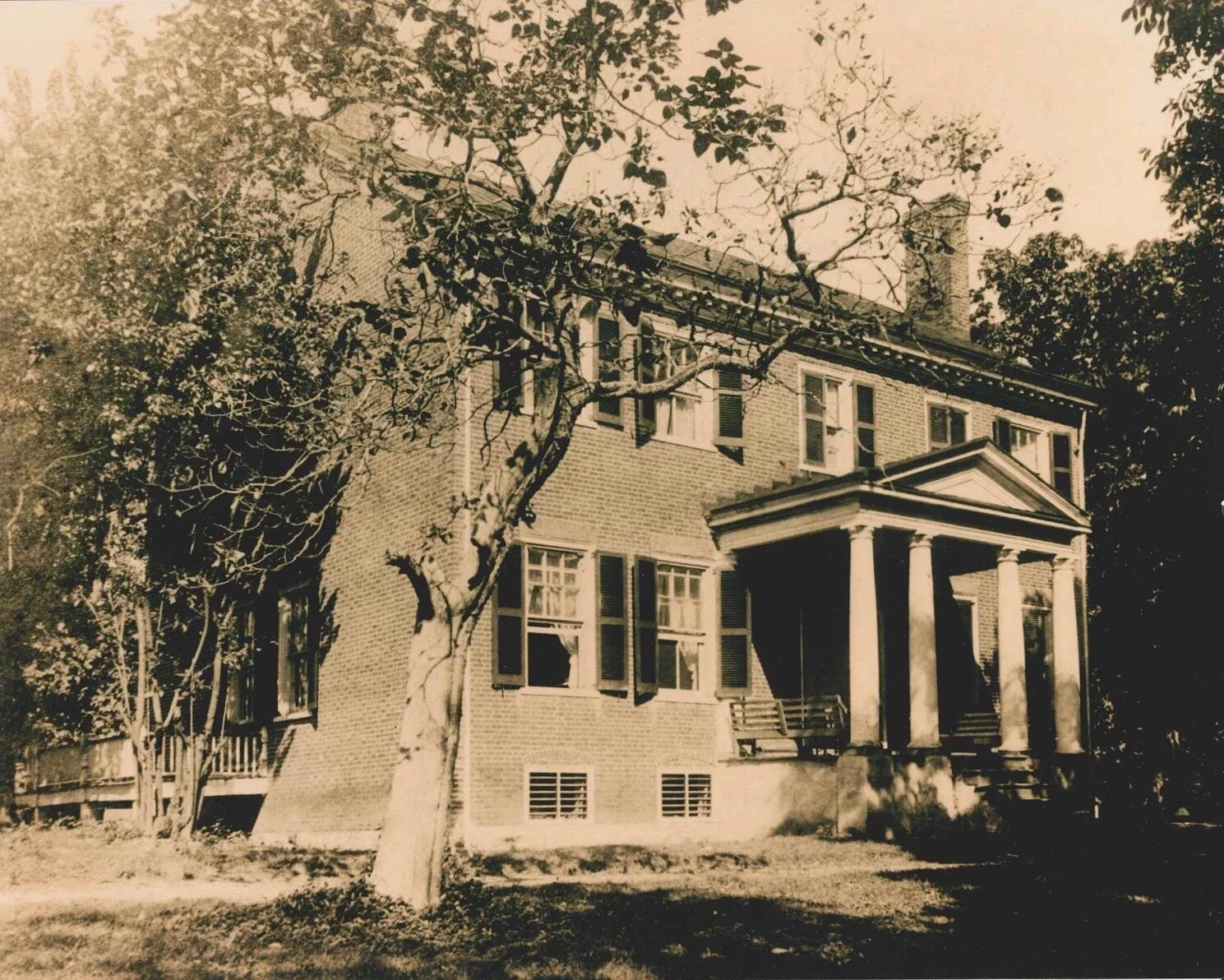
Like other contemporary Piedmont Virginia homes, the buildings at Morven are the product of the land's natural resources and the labor of those enslaved here. Higginbotham and his enslaved laborers quarried building stone and clay for brick, and harvested timber for building materials. Morven’s neoclassical design reflects a sophisticated network of skilled craftsmen—enslaved and free—who developed a distinctive regional style while executing Jefferson’s designs for Monticello and the University of Virginia. The house is situated on the highest plateau of Morven’s hills and valleys (the site Jefferson had earlier identified for Short), which provides expansive vistas, natural cooling with higher winds, and a measure of surveillance over the land and those who tended it. The plantation complex includes adjacent contemporary dependencies such as a brick kitchen and smokehouse, and a clapboard cottage (now called the Claim House) that likely predates the main house. Traces of plantation-era terraces that leveled the terrain are still visible and may have been planted with crops, vineyards, or orchards. David Higginbotham sought to hire an enslaved man named Phill to build Morven’s first garden in 1818, while the house was under construction, but the extent and character of Morven’s plantation-era gardens remain to be discovered.
Over the next forty years, the Higginbothams reordered Morven’s landscape from a group of tenant farms into a traditional southern plantation, enslaving over fifty people who labored in Morven’s fields growing tobacco, corn, oats, rye, sweet potatoes, and hay. Beginning in this period, the land began to witness increasing soil erosion and stream degradation, as well as decreasing crop yields from nutrient depletion. Higginbotham’s revenue at Morven extended beyond agriculture, as his enslaved laborers also worked in Morven’s mill and manufactured textiles for sale at the nearby Milton landing.
After David Higginbotham’s death in 1853, Mary Higginbotham and her married daughter Elizabeth Higginbotham Fisher relocated to Richmond, bringing with them Kitty Cary, who had been enslaved at Morven. Cary’s life was memorialized in the poem “Kitty Cary,” published in Harper’s Weekly in 1866; her descendant Lenora McQueen has located the cemetery where Cary was buried in Richmond and has championed that cemetery’s recent designation on the National Register of Historic Places.
Daniel Groff Smith and his wife Eleanor Buckey Smith of Loudon County purchased Morven from Higginbotham’s estate in 1853. The Rev. Lee Jones was one 56 enslaved laborers who were sold that same year from the steps of the “old cottage” at Morven (presumably the building now called the Claim House) as part of Higginbotham’s estate settlement. Jones recalled that the sale brought over $80,000. He was one of several enslaved laborers purchased by the Smiths who stayed on to work at Morven, but the majority were separated from their homes, families, and communities. Jones remained at Morven after emancipation working as a coachman and farmhand. His legacy remains on the land in the renaming of Dick’s Creek to Lee Jones Creek. According to Jones’s descendants accounts, recorded as part of Highland’s oral history, Smith renamed the creek as a tribute to Jones’s ability to protect the plantation’s horses by hiding them from Union troops in the forested creek valley.
The 1860 census shows that Smith owned 27 enslaved laborers, whose ages ranged from sixty to just six months old; sixty percent of these were under the age of 13. Until the end of the Civil War, Smith continued similar agricultural practices as Higginbotham, growing corn, oats, rye, clover, tobacco and sweet potatoes, with redirected emphasis on cattle grazing.
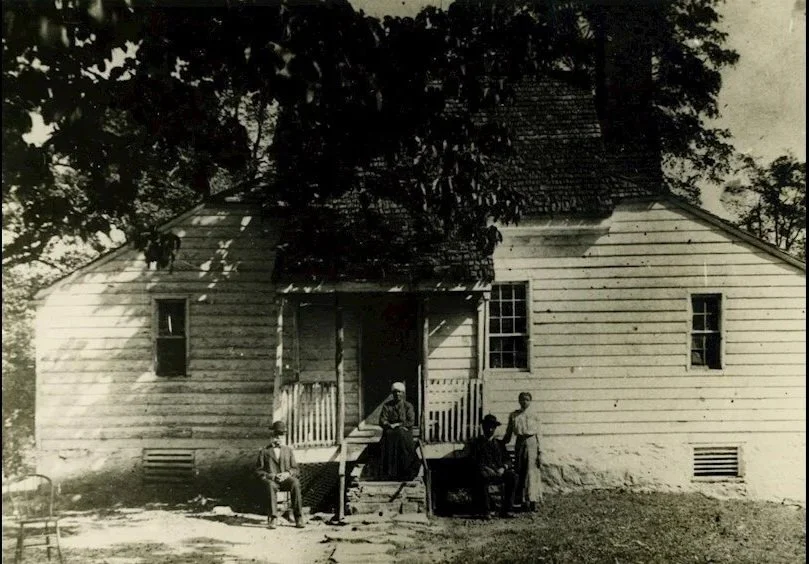
“Old cottage” at Morven (now known as the Claim House), undated but likely during the Edward Buckey Smith ownership era (1879-1906).
After Daniel Smith’s death in 1879, his son, Edward Buckley (E. B.) Smith, and E. B. Smith’s father-in-law, UVA Professor James Lawrence Cabell (who operated the UVA Anatomical Theater), bought Morven at auction. Morven’s land use is unclear and potentially unstructured during this time of social transition and economic instability in the South. We have much to learn about Morven’s social and environmental history from the end of the Civil War until the early 20th century.