
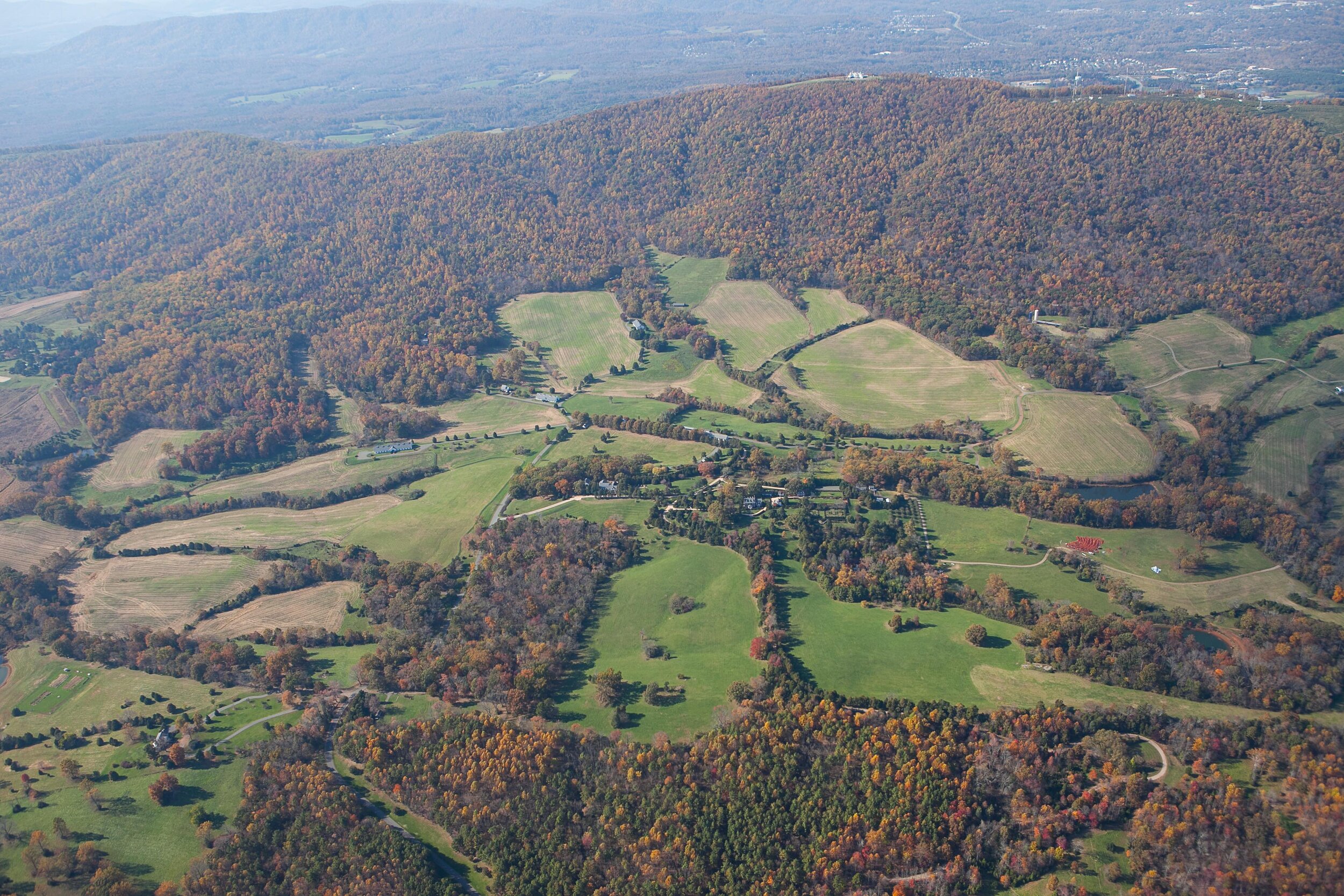
Morven Remade into an Estate Landscape: 1906 - 2001
Samuel and Josephine Marshall bought what we believe to be a financially destitute Morven Farm in 1906 and undertook substantial renewal of its agricultural fields and gardens. Based on their expertise owning a cattle farm outside of Madison, Wisconsin, the couple transformed Morven’s landscape from a plantation into a working farm by growing apples and raising cattle in Morven’s valleys. Josephine was the first president of the Albemarle Garden Club, which was founded at Morven in 1913. She enlisted the help of “Uncle Lewis,” an experienced local gardener, to reclaim Morven’s 19th century plantation terraces and to renew its gardens. Morven was one of the charter properties for Historic Garden Week and has been opening its doors for the Garden Club of Virginia since 1929.
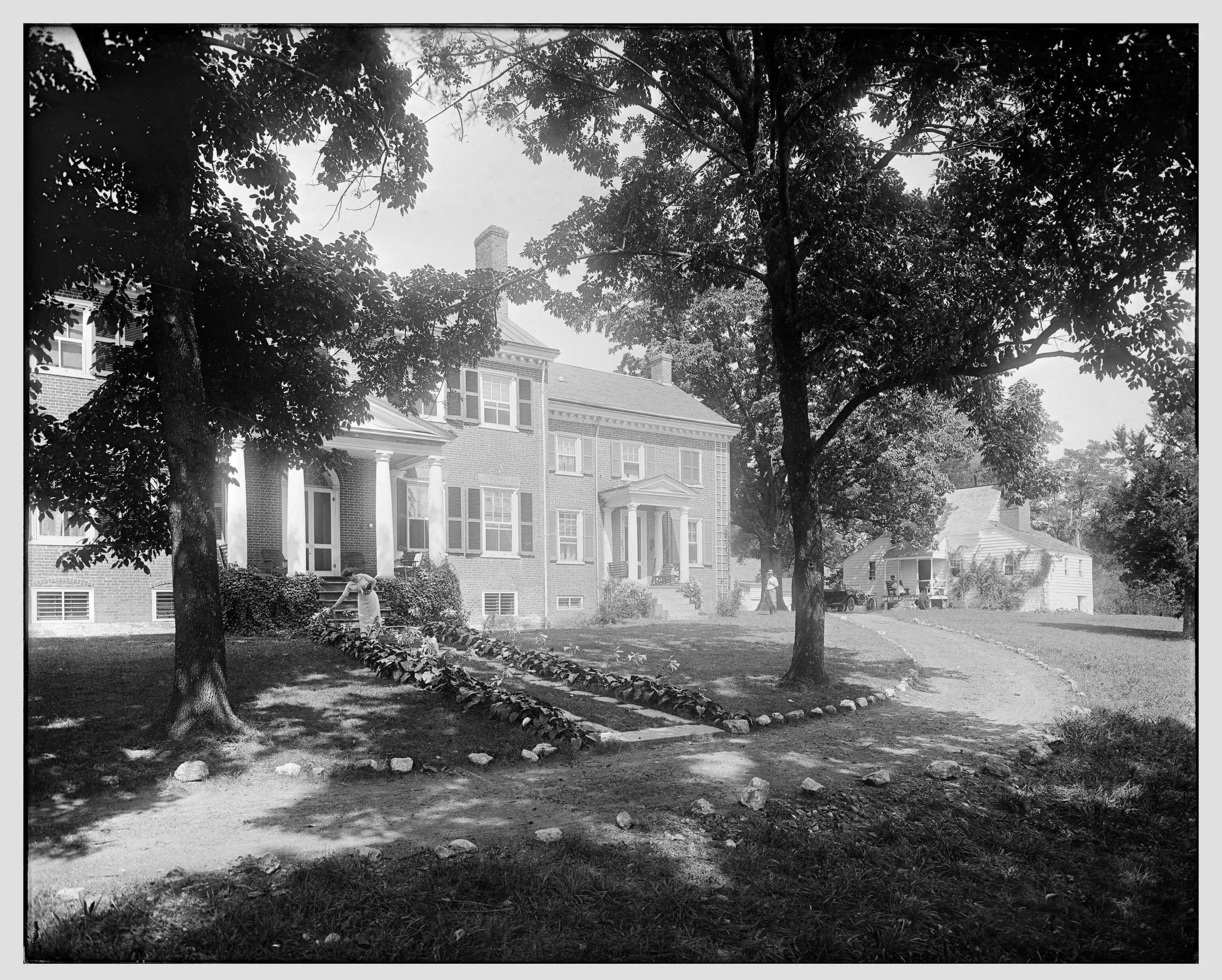
Rufus W. Holsinger, Morven House with Josephine Marshall and unidentified figures,
August 30, 1913, University of Virginia Library, Special Collections.
Renowned Charlottesville photographer Rufus Holsinger captured Josephine and Lewis’s horticultural handiwork in 1913. His photographs depict Morven’s sunken, geometric flower beds filled with billowing annuals and perennials, and the cutting garden filled with a combination of flowers, vegetables, and strawberries. Lewis, who we believe was born near Scottsville and worked as a gardener for the Rick family in Woodridge before he worked at Morven, must have been an accomplished horticulturist, as Josephine wrote that he propagated a large portion of Morven’s boxwoods from cuttings taken from a single plant and managed Morven’s greenhouse. He likely also assisted Josephine in the cultivation of a wild garden located in the wooded valley below the formal gardens.
The Marshalls renovated the house, and contracted Baltimore architect Howard Sill to design a two-story addition with a kitchen and a second staircase. They sold the property in 1923 to David C. and Margaret Patterson, short-term absentee owners who clear-cut Morven’s forests in a large-scale timber operation.
In 1926, Charles and Mary Stone of Oyster Bay, NY, purchased Morven and converted it into a country estate and stud farm. Charles was the co-founder of Stone & Webster (1889), an engineering firm that later played a leading role both in the Manhattan Project in Oak Ridge, Tennessee, and subsequent development of the U.S. nuclear industry, including the nearby Lake Anna nuclear reactor in Louisa County. Under the Stones, Morven acted simultaneously as a seasonal getaway and thoroughbred horse breeding operation. This period was also characterized by earth-moving and altered topographies that obscured the 19th-century historic landscape. The Stones improved the farm roads, built new barns, and relocated the colonial road (SR 795) as well as cultivated and harvested pine stands. As the couple only lived at Morven for short periods of the year, Morven’s grounds were maintained by a largely talented workforce of employees who lived on the estate year-round.
The Stones hired Annette Hoyt Flanders, a prominent New York landscape architect, to redesign Morven’s formal gardens in the 1930s. Her work at Morven continued until 1942. Flanders was one of the first women with a formal education in landscape architecture, having studied at Smith College, the University of Illinois, Marquette University and the Sorbonne. She had her own practice – which was a rarity at the time for a woman – and launched a generation of women in the field. Flanders worked in tandem with Joseph Everett Chandler, a colonial revival architect who was responsible for restoration efforts on Morven’s main house, including the addition of a west terrace, the renovation of the attic, and the addition of third-floor dormers. Chandler also contributed garden plans, and their combined efforts created a cohesive revival narrative that integrated architectural and horticultural design.
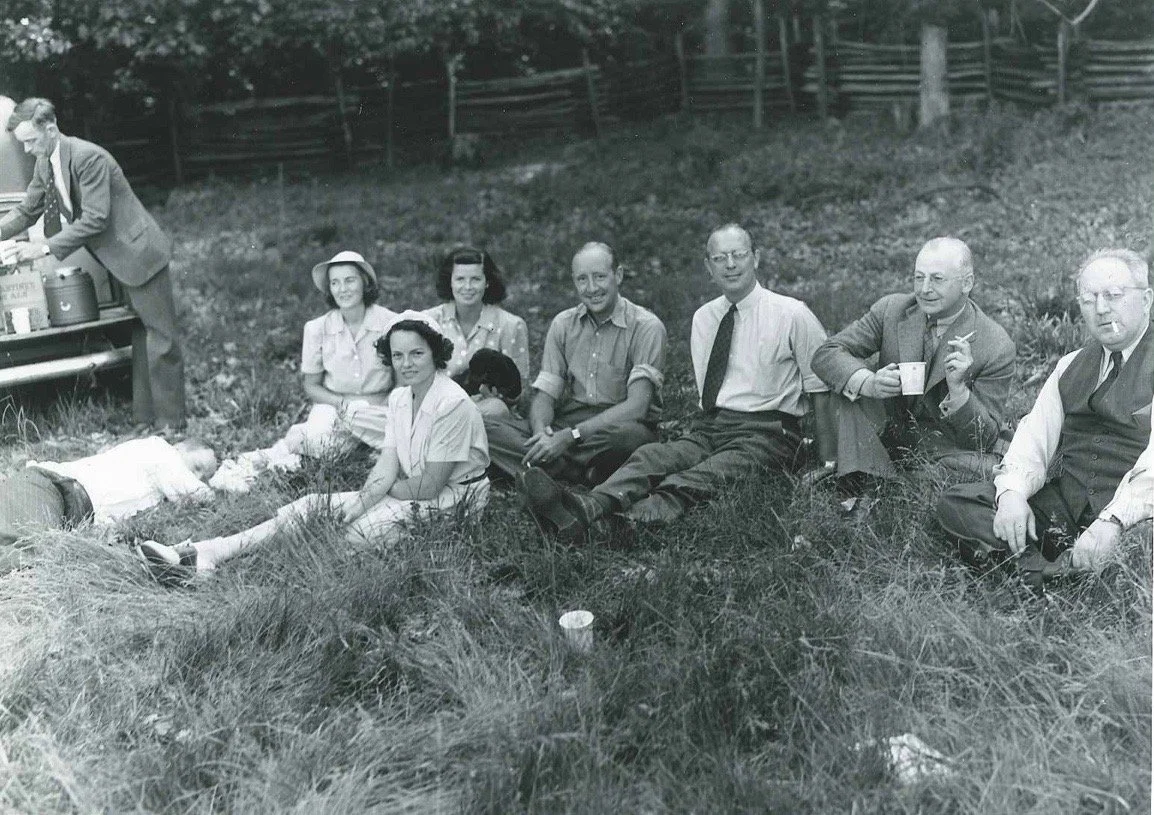
Stone family with Curtis Thacker (at the truck), 1930s, Morven archive.
The Stones hired Curtis Thacker–a descendant of Morven’s builder and designer Martin Thacker-as Morven’s head gardener in the late 1920s. He was succeeded by his brother, Thomas O. Thacker, whose son Ollie Thacker went on to work as the Morven Estate gardener for nearly 55 years, retiring in 2000. This remarkable continuity of care is reflected in the land as well as in the Morven Farm Journals, begun by Curtis Thacker in 1930 as a way of keeping the absentee Stones informed. The early farm journals document Flanders’ visits to the estate, providing detailed records of plant shipments, installations, bloom times, and daily weather conditions. Analysis of these drawings, plant charts and farm journals will allow historians and scientists to track Morven’s environmental history and compare it with documented changes in climate throughout the Virginia piedmont region. The journals, which continue still, are also rich in social and labor history, and document the Morven stud farm’s equestrian operations.
In the 1940s, after the death of Mary and Charles, Morven was inherited by Whitney Stone, and his wife, Anne Minor Stone. Morven Stud produced several famous racehorses, including a filly Triple Crown winner, and was featured, along with the gardens, in popular publications such as National Geographic. During the Stone’s ownership, in 1973, Morven was added to both the Virginia Landmarks Register and the National Register of Historic Places.